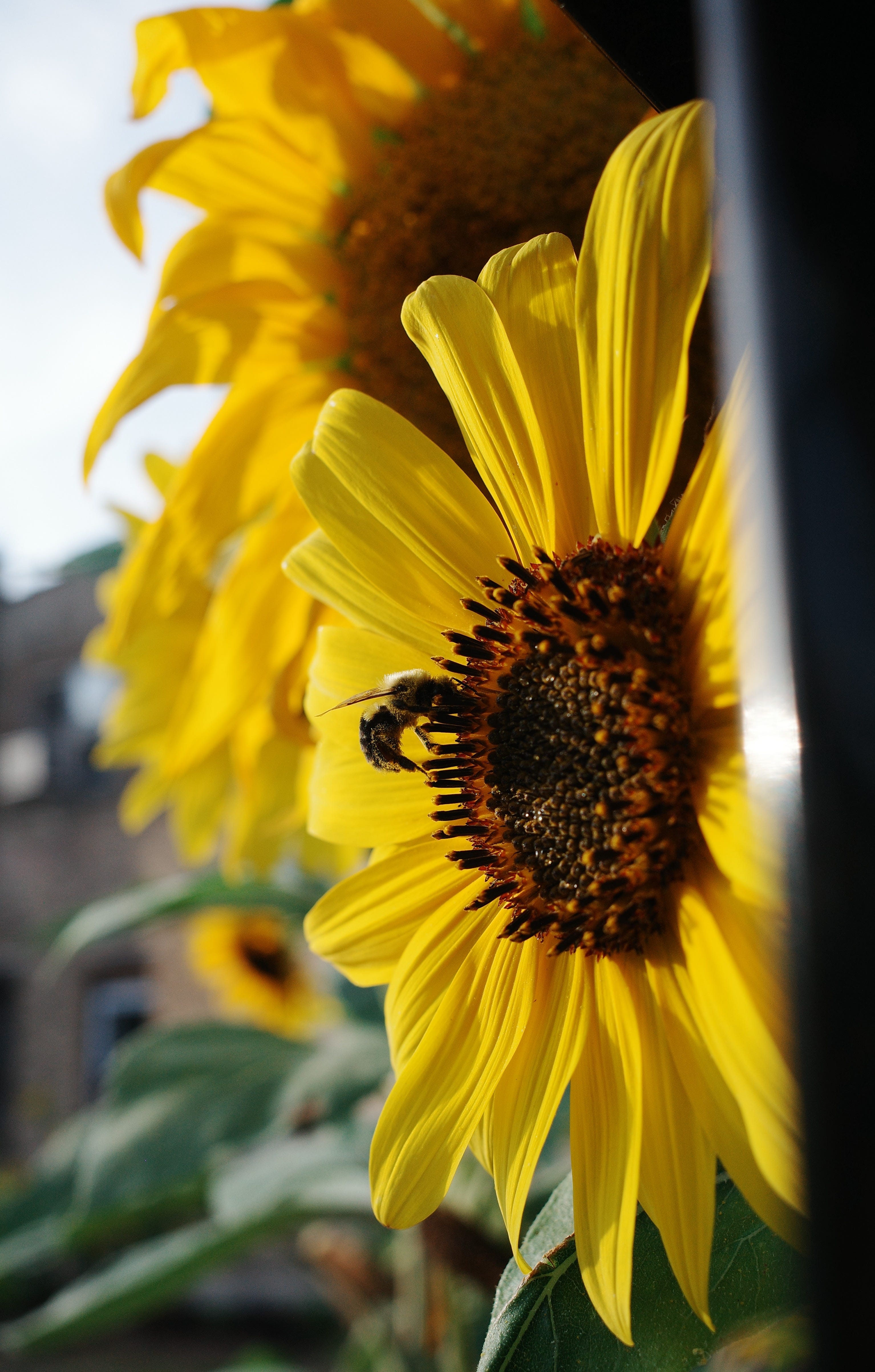
ft. on grief
a little essay for myself, to myself and whomever needs it

The other day I was driving to Lennie’s agility class, seemingly taking the long way by zig zagging my way through Chicagos grid during rush our while listening to Ocean Vuong’s On Earth We’re Briefly Gorgeous. There’s a point in the novel where Ocean talks about how his grandfather went in to get cancer on his neck checked out in removed, then he came home almost as quickly as they identified the cancer. I think he continued on by writing about his grandfather, but i had to go back an re read that section. Recently I lost a friend, Greg, who passed to cancer. For some reason, the fact that Ocean Vuong’s grandfather survived sent me into a spiral realizing that my friend didn’t. He fought, and he fought, and he fought. I was supposed to see him the following week.
Greg and I worked on a project called Disability Incarcerated, interviewing youth of color who are in institutional facilities across the country about their educational experiences. I was brought onto the project quite late to support in data analysis, listening to interviews, buildings codes and aiming to understand the youths educational journeys. Greg was there damn near from the beginning. His energy, charisma and love for the youth was evident from our first zoom meeting when I was getting onboarded. This was then reaffirmed when I would listen to interviews where Greg was interviewing a young person, subsequently being able give Greg a hug in person while in San Diego for a wedding. He treated them not only with respect but allowed them to feel seen, kids who were written off, thrown away, or felt the education system didn’t value their version of intellect, but Greg did. In this country we spend more money on the prison industrial complex than we do youths educational experiences, facilitating the pathway to prison through schooling. This is particularly evident for young people who are of color, have disabilities, grow up with limited resources and a host of other political and economical influences. Greg understood this too, particularly that the youth loved to learn, they loved things like making music, doing art, caring for their families, and he allowed for them to show that and disrupt the narrative that these young people are disposable.
I haven’t been processing Greg’s passing very well, not to say I haven’t been trying. For the longest time I thought I was ok with death, supporting others as they move through it, organizing the rally for someone who’s been murdered by police, showing up for people by donating for a meal train and what not. Realistically I don’t think I’ve known how to process loss well, and it takes me a while to collect my thoughts and put them somewhere. For instance, my friend Brian and I (who knew Greg) have been working on the project and we had a paper deadline coming up. We opted to write and finish this paper because Greg would’ve wanted us too and he would’ve been coaching us through how to identify the paradox and usefulness/uselessness of educational theory. It was helpful, for a moment. Then I realized I hadn’t processed a number of moments of grief, a number of losses over the last 6-7 years. I think I’ll be able to get into them when I’m ready to write and share them out, although not sure what format they’ll come in.
I came to realize how much grief speeds up time, whether it’s the feeling of time lost, or the feeling of needing to do more, do less and change everything up. For me, I often feel a sense of urgency to do more, to care more and make sure others feel ok, and that sets me up for a self betrayal in that I’m giving fragments of myself out that aren’t even coherent enough to make sense. One of these instances I had to return to more recently was when my friend and comrade Elijah Lewis was shot and killed. I had first met Elijah at Estelita’s Library, getting connected through mutual friends, and he was getting his financial literacy education program together and I was helping him think through it. This was in 2021. Over the next couple of years Elijah and I had met a number of times to think through how he could build up this program, sustain it and fund it. Then he was killed. He was picking up his nephew to take him to a monster truck show, and a man passing on a scooter and him exchanged words as Elijah pulled back into the street, then the man shot a number of rounds at the car as Elijah drove away, striking him and his nephew. Elijah died that day, this was 2023.
Elijah was the charismatic type too, similar to Greg. He was 21 when I first met him, a young self assured and articulated community activist. Realistically he just cared for Black and Brown people, young, old, whomever was experiencing injustice in Seattle’s Central and Southend. Over the next couple years till I left Seattle I couldn’t attend any of the vigils, gatherings or celebrations of life for Elijah, or rather I wouldn’t. For some reason I wasn’t ready to work through that pain. He was the first person I knew in a deep way that I’d lost and I didn’t have the tools to work through it.
About a week ago I got the urge to hear his voice again, I think because of the way I can hear Greg’s voice in the interviews he did. So I went to youtube and found of his talks that he gave to Converge radio, a Black radio station in Seattle. I started hysterically crying hearing him talk about what he’s doin, talking about the community I also know and love, and his dreams for it that I was bought into. Then I realized he’s not able to see those dreams come to fruition, at least not here earthside.
Both Elijah and Greg’s deaths are some of my first intentional attempts at grieving, particularly focusing on what it means to lose someone while desperately clinging to their memory in different ways. I’ve come to realize I’ve been grieving a lot without really understanding it fully. I grieve places I’ve lived, the relationships I built there, the memories. I grieve people, my love and care for them, and the wishes for futures we’ve shared. I grieve the unknown too, which I think makes this feeling different from nostalgia. I struggle with remembering moments due to my multiple sclerosis, and likely from playing football my whole life. I grieve moments that I don’t know happened, or rather can’t retrieve the memory itself at times unless prompted or it being shown to me. I think this brings me more to understanding that I thrive off of sensory memories, touch, smell, sight, hearing and taste. It’s strange to be sent back to a specific moment because a sensorial pull transports you there through time like Matthew McConaughey in Intersteller, reaching through the fabric of time back to yourself because love is a portal, too, one that transcends time, and I think grief does as well. I’ve been working to better identify and work through some of this grief, remembering some of the moments to work through them and slow down to be with them. As grief speeds up time, I’ve moved quicker too, and not realizing how much it’s had a full foot to the throttle for so long. Here’s to celebrating the voices, the images, the smells and feeling of people, places and things we love and have lost. I don’t share this to articulate its ease, but to illustrate a way I’m working through it.
Writing and reading has forever been a process for me to make sense of the world. When I’m reading something I feel I’m in constant conversation with them, finally feeling safe enough to coalesce in such a way that dialogue occurs in between the lines. This also happens for me when I’m listening to music, particularly music that sounds like a portal to the elsehweres and elsewhens. The part of this that I’ve struggled with is how to process the grief of those who have allowed for me to do that, specifically referring to D’Angelo and Alice Wong passing in the last month too. For many folks in the generation before me D’Angelo is a magical, almost ethereal. His version of neo-soul sounds like a hug, gospel resonance and your greatest love giving you an affirmation all at once. For me though, and I think many others in my generation, D’Angelo was about of the neo-soul playlist on repeat on sunday mornings when we’d clean the house. My mom growing up would have music playing all the time, and don’t get it twisted, she comes from the midwest prince era of music heads so of course I was forever put on (the lineage of influence between prince and neo soul artists is so real). D’Angelo for me always felt like home, and his music has always felt like a reference point for me to understand what it means to be a man in a particular moment, to allow myself to feel. So, during the last month as the multitude of losses compounded, so too has the plays of voodoo, brown sugar and man on the moon (b/c Scott Mescudi saved a lot of us too). For me, music like ‘I found my smile again’ and ‘soundtrack 2 my life’ serve as a portals for me to refind myself in the emotional nebulas that happens to be my mind at times.
Grieving here, at least for me, feels like an impossible project at times, and I’m convinced it’s supposed to feel that way. Not necessarily in a negative way, but in that way of grieving necessitates learning how to grieve and process and be in the world as a different version of your previous self. Alice Wong, disabled oracle and a disabled auntie in my mind, helped me me realize that after first reading excerpts from her book disability visibility, learning is a place, it’s a set of evolving relation that reverberate through your body and mind too. As someone who transitioned into my disability, delineating the difference of being born with it, her writing (amongst many others) allowed for me to be seen along the pages edges and across the stories within the binding. I was able to be made visible to myself in those moments.
At the point when I was in the hospital, fresh of a small stroke and my first relapse of multiple sclerosis, I was told I couldn’t play football any longer. The doctors didn’t use the language of disability, but they clearly communicated that my body wouldn’t allow me to partake in the sport that had defined my life up to that moment. Despite that, as I sit there witnessing my parents in tears at the news, I was left feeling a sense of relief, to be done. I don’t think I played football because I loved the sport as much as I loved my friends, some of my coaches, and wanted to get out of Phoenix. It was a pathway for me to figure myself out in a lot of ways, with a bulk of those being unhealthy at times, but nonetheless set me on the path I’m on now. It’s interesting too because football and sports generally deal with disability and disablement a lot. People getting surgeries, getting hurt, medically retiring and so forth. But at the time I was left wondering, what does a transition into disability mean and what does it mean for my future? At the time i didn’t realize or know what that even, but over time it felt like invisibility. Not literally that I was invisibility but rather that a part of myself was something that folks would shudder at when they heard ‘multiple sclerosis’ and that my future was determined by this disease. This determination was broadly in conflict with the future I thought I would have, a good job, family, kids, etc. Come to find out, MS really made it hard for me to imagine those things, and i swiftly felt trapped in the grieving of an unknown future. One where I couldn’t envision parenting a child while having a disability, or being a good partner, or being an athlete, being able to do the things that I had grown accustomed to making up my being. Alice Wong’s edited book Disability Visibility made me view myself fully, well it didn’t start that way, as I mourned other parts of myself. But she offered stories and answers to questions I didn’t know I needed, questions that could only emerge between the lines.
I’m not sure I feel any more sure about my ability to live up to these futures that society and the status quo has set out for me, and with that said, I’ve found grief and my process of grieving and remembering as a way to see fractal versions of myself coming together in unison in a new configuration. Not to say I’m better or worse than I was before, just a version of myself that i know better.
I want to be colored in, or rather allow for it; i’m both wanting to be seen, and terrified by it, i want to be seen and not surveilled, i want ppl to inquire bc i struggle to be forward in sharing; i want my will to change to be stronger than my fear of living.
I’m working to remind myself that when I remember, that memory is a second chance and how losing someone (including myself) creates more of us, splitting in multiple arrays. In a way, grieving allows us the opportunity to aim to become things we haven’t necessarily experienced or witness otherwise in our immediate circles. In some instances, sadness is my greatest teacher, in others I’ve realized feeling allows to decanter myself and realize sonder and my connections to other pieces of life that deserve to be visible.
I suppose I ask you then, how have you come to learn your body and how are you grieving what’s unknown?